Thursday, 7 November 2013

Learning to be ignorant

It's been a while since my last blog post, and I'm afraid I can't say that this is because I have been too busy doing things to sit around writing about them. There have been plenty of long bus journeys and lazy afternoons that I could have devoted to writing if I'd felt so inclined. But since I got to Argentina six weeks ago I have felt, paradoxically, that although it is late in my trip, it is too early to write anything about it. I feel I will only be able to reflect on things properly when I have crossed back over the ocean, said my goodbyes and hellos and slotted myself back into familiar, comfortable surroundings. Only then will I be able to pass judgement on this experience and to say with anything like conviction what it has done for me and to me.

That said, there is one lesson that I have learnt and that I keep on learning, over and over again. Over the past weeks and months, I have been developing an acute awareness of my own ignorance and insignificance. I always knew, in theory, that the things I don't know greatly outnumber the things I do, and that in the grand scheme of things my life and my small contributions to the world count for very little. But there is nothing like travel to hammer this fact home, to make one feel it as well as know it.

Don't think I'm feeling inadequate or craving reassurance; this is, beyond all doubt, a good thing. I have been liberated from my own sense of self-importance ever since the moment in America when, pulling weeds in a flowerbed, covered in sweat and soil, aching all over and thoroughly happy, I suddenly realised that I couldn't care less about my essay marks and exam results and what an anonymous professor thought of my masters thesis. All the stresses and strains of competitive, fast-paced academia seemed utterly pointless. The world doesn't care about deadlines, grade boundaries and referencing styles, and nor, in all honesty, should I.

Then, shortly after arriving in South America, I spent a week volunteering in a Hare Krishna ecovillage and yoga ashram. I knew nothing about the religion, was a weak, feeble and impatient gardener, couldn't hold a yoga pose and was barely able to string a sentence together in Spanish. But unlike in Cambridge, where the only requisite character trait is an ability to wax lyrical about all the Stuff You Know, I was perfectly happy to be so thoroughly ignorant. There was no shame in it; I was ignorant but I didn't feel stupid. In that tiny, happy corner of the world, enthusiasm and open-mindedness count for infinitely more than skills or prior knowledge.

Since then my trip has been enriched by the many encounters with people who know more, have done and seen more, who speak better Spanish, and whose adventures make mine sound about as challenging as a Thomas Cook beach holiday. In an almost-empty youth hostel in the tiny Patagonian town of San Martin de los Andes, I met a woman named Loretta who has been cycling around the world alone for the past four years. People like to say that travel is about broadening one's horizons, and my horizons have been broadened by walking in national parks, driving over mountain passes, crossing borders, talking to people in hostels, learning how to garden, seeing beautiful things and ugly things and sharing snippets of other people's lives. Loretta's horizons have been broadened by trekking all night across the Mongolian tundra with a party of nomads, camping alone in the mountains, driving through Kenyan bandit country with a sleeping armed guard, being chased by the Iranian police, sailing across the Atlantic, confronting a South African phone thief and, most recently, getting knocked off her bike by a long-distance bus. Our horizons do not even compare. My capacity for adventure is higher than some, but next to people like her, I am a cowardly couch potato.

There have been moments where I have kicked myself for not being a Loretta. Sometimes I think I should have tried harder, gone further, stopped at nothing. Sometimes I think my trip is better defined by the things I didn't do rather than the things I did, that it has been devalued by all the times I let laziness or fear beat back my curiosity. But mostly I am humbled. Mostly I think that one of the most important things I will take away from travelling is this understanding and acceptance of my own colossal unimportance.

Friday, 20 September 2013

Why travel is no holiday

There are times when I think the inherent interest of travel is less in the doing than in the having done, that it is more appealing in the past and future tenses than in the present continuous. 'I'm going travelling' sounds brave, intrepid and exciting. They were the words that most motivated me as I struggled to meet deadlines, survived on stodgy canteen fare and stared out of my window at the grey, English sky. 'I've been travelling' has a noble, satisfying ring to it. Perhaps, when I get back to family and friends, Sunday morning fry-ups, Doctor Who and my own bed, those words, and the licence to say them, will be my ultimate reward.

'I am travelling' has entirely different implications. It lacks the finality and the sense of purpose of the previous two. 'Right now' or 'at the moment' might be tacked on the end to emphasise the temporariness, not only of the act of travel itself, but of every single experience that that act encompasses. Travel is a limbo state, when you do not quite belong, when you are not entirely Here but not yet There either. Sometimes, the words 'I am travelling' exhaust me. They make me crave stability and stasis. When you add the word 'alone', as I often do, they take on a subtle hint of sadness.

Sadness is a recurring theme of travel writing, as I am learning. Paul Theroux's anthology The Tao of Travel is full of gobbits from melancholy nomads bemoaning their chosen way of life. In 1807 the Swiss novelist and essayist Madame de Stael described travel as 'one of the saddest pleasures of life'; Theroux himself calls it 'a sad and partly masochistic pleasure.' During the road trip recounted in 'Travels With Charley', John Steinbeck suffered bouts of loneliness, taking solace in occasional visits from his wife Elaine, to whom he subsequently wrote 'I'm glad you came out and it was a good time, wasn't it? It took the blankness off a lot.' And just the other day, on a blog whose name I've forgotten, I came upon a quote from an author whose name I've also forgotten: 'It's not an adventure if you're not miserable.'

When this trip was only an idea, it didn't occur to me that travel might make one sad. I thought it would consist of moment after moment of unbridled joy, wonder and awe - until the week before my departure, when I was convinced it was going to be hellish. The reality, of course, is somewhere in the middle. It follows the emotional trajectory of most other lifestyles: a reasonably smooth continuum of being okay or being fine, peppered here and there with moments of delight, inspiration, excitement, misery, weariness and dissatisfaction. Before this trip, travel was one of the purest forms of happiness I knew. But I realise now that when I thought I was travelling, I was really just going on holiday; novelty and foreignness were a source of delight primarily because they were thrown into relief by the impending return to familiarity and routine. When you adopt travel as a way of life rather than a break from it, you realise that it is not and cannot be immune to the ups and downs and moments of blankness that life invariably presents us with, however happy we consider ourselves.

I recently had a conversation with an American who was on a brief trip to Montreal. It soon came up that I was on an extended backpacking trip, and he expressed his approval.

'But it's hard sometimes, you know?' I said.

'Haha!' he cried. 'First world problems!'

He's right, of course. Part of me is irritated by my inability to appreciate my own immense privilege. I feel I should be grateful for every waking second. But then I cut myself some slack, and tell myself it's okay not to be delighted and amazed and awestruck all the time. It's okay to be just okay. If anything, this experience is a reminder that our tendency to look back fondly on our best-loved memories - and to forget the neutral, uneventful, neither-happy-nor-sad moments that make up the bulk of existence - tricks us into believing that a lasting state of pure happiness is a conceivable and attainable thing. But even the things we idealise and dream about have rough edges when you see them close up.

This doesn't mean I don't like travelling, or that I wish I wasn't doing it. It just means that it is a different experience to the one I was expecting. And quite frankly, so much the better. After all, if I were only happy when travelling and travelling only ever made me happy, how on earth would I be able to go home?


PS. I realise my blog entries of late have been a) few and far between and b) not particularly informative as to what I'm doing and when I'm doing it, and that consequently this blog is less an account of my travels than a mish mash of random anecdotes and not-very-deep reflection. However, I have come to realise that there's really not much point in me describing things for the sake of describing them, because it bores me, and I'm rubbish at it. For the record, I'm in Quebec City, in a nice, friendly hostel in the old town, and I'm about to go exploring. Apologies to those who would like more details, but for now, that's all you're getting.

Tuesday, 10 September 2013

Going back

I'm not quite sure where the time went, but the first leg of my journey is over. Well over, in fact. It's been nearly two weeks since I hugged my seventh and final American host goodbye, got on a train that crawled through the Adirondacks, crossed another border and arrived in Montreal tired, excited, and alone. The part of my trip that consisted in large part of me staying with friends in a country I had visited before, during which I had some knowledge of what to expect, and where English was everyone's first language, is behind me.

Here's what I did in America. I traipsed through the big city and did nothing in the deep countryside. I explored towns I didn't know and revisited ones I did. I rode in cars, trucks, trains, buses and boats; slept in dormitories and cabins, on sofas and on airbeds. I had conversations with strangers; made new friends and caught up with old ones; met their families, pets, partners and roommates. I swam in the sea, ate al fresco, saw fireworks; I chopped wood, picked blueberries, learned to arrange flowers, and developed an obsessive fear of ticks. I played board games, went to a drive-in, ate my own weight in pancakes, rode a segway, saw live music, went swing dancing, failed at zumba; I read things, wrote things, thought about things, talked about things, listened to things, and learned things. 


Birthday breakfast


Wilder Hill Gardens, Conway, MA: my home for a week


One of many country walks

And yet I was plagued, from time to time, by a nagging feeling that I was somehow cheating by staying with people I knew in places I had already been - that however fulfilling and challenging the trip, I wasn't really travelling at all. A recent purchase - Paul Theroux's anthology of travel writing, The Tao of Travel - would seem to confirm this. Theroux's kind of travel is valuable precisely in that it forces you away from the comforts of the familiar and into the position of an outsider. It is, he writes, 'a leap in the dark. If the destination were familiar and friendly, what would be the point of going there?'

But I happen to think a lot of familiar, friendly destinations. Going onwards is important, of course, but going back is important too. What, after all, is the point of falling in love with a place if you never return to it, or of making happy memories with people if you never get the chance to make any more? My trip to America was about finding a series of temporary stopping places rather than, as Theroux writes, 'being always on the move towards an uncertain destination'. It was less about forging fleeting connections with people and places than about revitalising connections that had been dulled by work, responsibility, and distance. I was not a traveller à la Theroux: always peripheral, always a stranger, in a perpetual state of passing through. Instead, I became a temporary member of successive households and communities. I returned. I retraced my steps. I remembered why I wanted to return at all, why these people and these places mattered to me to begin with.

Now the adventure continues, into the unknown.

Friday, 23 August 2013

Raising hell in Boston

I know I ought to be churning out blog posts about western Massachusetts, which is where I have spent the majority of August (for the record, I love it here, and I'm certain I'll be back). There is plenty I could be writing about: the things I'm learning, the people I've met, the respective experiences of travelling in the countryside and in the city, the reunions with old friends and the subsequent goodbyes. I could write about the week I spent weeding, hoeing, fruit picking and laying hay on an organic farm with my new friend Lilian and a pair of kittens. But what I really want to write about, friends, is my experience of touring Boston by segway.

Rebels.

It wasn't part of my plan to go on a segway tour. Nor was it part of my plan to go back to Boston, but I turned out to have a few days unaccounted for, and my friends Kate and Clare generously offered to host me at their apartment in the North End. When I arrived they listed a number of potential Boston activities I might like to partake in during my stay. They admitted slightly abashedly that they had long been wanting to go on a segway ride, and now they had the perfect excuse: an out-of-town visitor who ought to see the city. The out-of-town visitor did not take a great deal of persuading, and when her hosts offered to cover the cost as a birthday gift, she was, as the French say, partante.*

Generally I shun organised city tours because I resent paying the price of a kidney for whistlestop ride around monuments and buildings I'd rather just visit on my own. But a segway tour struck me as being altogether different. For one thing, it was to be a full two hours long. For another, IT INVOLVED RIDING A SEGWAY.

More conventional modes of transport allow the sightseer to retain a modicum of dignity, but such a small one that it is barely worth bothering about. Tour buses are filled with foolish-looking people pretending to be serious adults. The first rule of segway-riding, however, is that you must leave your dignity at home. You must throw yourself into the task with childish, unironic enthusiasm. You must embrace everything about the experience, from the complimentary 'Certified Glider' photo cards that mean precisely nothing, to the yellow plastic walkie-talkies that dangle attractively around your neck without transmitting any audible information, to the surprising but inescapable fact that you are on a segway, in public. You may tell yourself that those who stop and stare are merely admiring of your courage, or jealous of all the fun you are having, but it is preferable to admit early on that they are really doing so because you look ridiculous, and, when all is said and done, are ridiculous.

When the fateful hour arrived, we set off for the depot, kitted out in sensible closed-toed shoes and drawstring rucksacks (actually, that was just me). On arrival we were shown an instructional video in which an unfortunate stick person endures a series of near-fatal segway accidents. I will admit at this point to feeling a certain reluctance about proceeding to the next activity, which was to get on an actual segway. I do not need safety videos to remind me of the finite nature of existence or the fragility of the human condition, and I wasn't sure I wanted to add 'freak segway accident' to my ever-lengthening mental list of Ways I Could Potentially Die. Nevertheless, I followed my friends to the segway-mounting area, where a small but ovoid man instructed us to choose from a selection of flattering helmets. We met our fellow segway tourists (gliders), a trio of boisterous middle aged ladies named Janet, Mary and Olga, one of whom was wearing a T-shirt that said 'I LIKE SEX and the city'. After five minutes of instruction we were all pronounced qualified, and then we were on the road. Not the pavement, friends. The road.

We were told to stick together no matter what. If Jeff, our instructor, went through a red light, we were to follow him through it. If he rode out into the path of an oncoming vehicle, we were to follow him into it. It didn't take long for someone to ignore these directions. At our very first intersection, Olga took it upon herself to wait for an approaching car to pass instead of following Jeff across. I don't know what the collective noun for a group of segways is but I suspect it may be a swarm when in motion and a gaggle when stationary, and at this point, the distinction had become confused. Those ahead of Olga swarmed away, oblivious, while the rest of us gaggled nervously behind her, feeling unpleasantly vulnerable without Jeff, who was dashing about trying to round us all up. It is infinitely preferable when the same collective noun applies to everyone.

'But there was a car coming!' Olga protested, when we were reunited.

'Cars stop for segways,' replied Jeff, and I am happy to report that he seems to be correct. The compassionate driver is no more likely to mow down a swarm of segways than he is a family of ducks. It's a good thing I discovered this before we crossed the two most perilous intersections of the ride, which Jeff, as he cheerfully informed us, likes to call 'Frogger Level One' and 'Frogger Level Two'.** A total of eight lanes meet at Frogger Level Two. I have to admire Jeff, who leads parties of inept gliders across this deathtrap on a daily basis. His ability to remain calm throughout the process will forever be a mystery to me.

What with all these potential hazards, coupled with the need to actually control the thing, segway-riding takes a lot of concentration. For that reason, it isn't the best idea if your purpose is to actually see the city, because you generally have more pressing concerns than admiring the view. Ask me which parts of Boston I went through, and I can barely remember; I was too busy trying not to mow anyone down. But I don't think anyone really goes on a segway because they want to see the scenery. They go on a segway because they want to go on a segway. You may tell me you don't harbour a secret desire to do the same, but I can't promise to believe you.


*Game, ready.
**Apparently Frogger is a game in which the player must direct a frog to cross the road without getting splattered. But maybe you knew that.

Wednesday, 7 August 2013

Everything I know about Henry

Henry is a small dog of indeterminate breed residing in Conway, Massachusetts. Here he is, indulging in one of his preferred pastimes:


Henry is mostly terrier, and this may be why he is sometimes driven to bark furiously at passing cyclists, other dogs, and tall, unknown men. But for the most part he has a gentle, friendly demeanour, and demonstrates his affection for his human companions by sleeping on their beds, climbing into their laps, offering them his paw, and occasionally chewing their socks.

Henry has long, thick locks, particularly around his rear end, which is capped by a cascade of grey and white tail. His legs are similarly hirsute, although the voluminous hair that covers them shrinks significantly when wet. If his daily walk takes him past a river, Henry may feel inclined to paddle a little, which reveals the fragile skeleton beneath the fur and gives him the appearance of wearing pantaloons. The hair on his stomach is also plentiful, and is useful for warming one's hands on if it turns chilly. But the crown jewel of Henry's coat is the hair on his head, which invariably looks handsome whether it is brushed backwards, forwards, upwards, outwards, sideways, or simply parted down the middle. Henry endures human attempts to style his forelock with patience and stoicism.

For the benefit of his health, Henry is taken out for a constitutional twice daily. Since he lives at a (non-metaphorical) crossroads, the options for this are many. He can be taken up the hill into the woods, down the hill to the cemetery or the river, or towards the town centre and over a covered wooden bridge. Each route is equally picturesque and equally aromatic, although all the years he has spent in Conway have left Henry a little blase about the visual and olfactory scenery. Sometimes he puts his foot down and says outright that he doesn't want to go, and may express his desire to turn back shortly after setting out. But on other occasions he quite enjoys himself and declares, when it is time to go home, that he would much rather carry on walking. It all depends on the mood he is in. He is approaching middle age and knows his own mind.

The main purpose of these outings is to give Henry the opportunity to perform his daily necessaries. He does not have access to a W.C. so it is important he use the time wisely. On a good day he will perform enthusiastically in full view of the assembled company, who may feel called upon to make observations about the colour and consistency of what he has produced. Fortunately Henry is very open about these things and does not consider such comments an affront to his dignity. On other days he is less enthusiastic about the task, but since a failure to perform inevitably results in the walk being extended or repeated, I suspect his reluctance may, at least in some instances, be feigned.

Chief among Henry's talents is his ability to elicit sympathy from his human companions, even in circumstances where no sympathy is due. For example, if he should appear disgruntled at being denied doughnuts, ice cream or Chinese food, someone will always say 'oh, poor Henry', even though a luckier, more comfortably situated dog has never been known to exist. Then he may be picked up or have his ears petted, or given some kind of canine delicacy from a special drawer, or simply have sweet nothings recited to him in a voice reserved especially for the purpose. If Henry's feelings are injured, his companions are always anxious to comfort him by whatever means are available to them.

It is all because there is something beguiling about Henry. It is to do with the way he uses his eyes and ears to articulate his thoughts, and with the shape and size of his head, which fits perfectly into a cupped hand, and it may also have a little to do with the dainty row of teeth visible beneath his snout. It is largely due to these charms that an encounter with Henry inspires instant love and devotion.

From a distance, Henry appears to be a dog much like any other. But once one gets to know him a little better, one realises that he is not simply a dog, but a canine person.

That is why you don't forget Henry, once you have met him.

Tuesday, 30 July 2013

Alone on the Cape

I'm writing this from the quiet, leafy paradise that is Conway, Massachusetts, but more on that in a later post. First, an update on my solo trip to Cape Cod last week.

After my stay in Boston I had a few days to spare before I was due back in New York to help my friend KC move out of her apartment and home to Conway. I was keen to go somewhere I'd never been, so I got on a ferry in Boston and sailed across the bay to Provincetown, where I stayed for two days in the town's only hostel. Then I took three buses and another ferry to the island of Martha's Vineyard.

I had a very pleasant time on Martha's Vineyard, and consequently I have less to say about it. The hostel was clean and airy, and provided free pancakes every morning; I met some friendly people, visited some pretty places, and ate some nice food. Provincetown was a different story, but ultimately that was a positive thing - it provided me with food for thought and plenty of fodder for a blog post.

I'll say right now that I am probably one of the only people on the planet not to have enjoyed themselves in Provincetown. It is bursting at the seams with people enjoying themselves. Perhaps I'm old before my time, but that is precisely why I didn't enjoy it.

P-town, as it is affectionately known, is a small, picturesque seaside resort at the northern tip of Cape Cod, the long, thin peninsula that juts out of southern Massachusetts and curls north towards Boston. It is crowded with seafood restaurants and artists' studios; its main street follows the shoreline and a goodly number of its many bars and restaurants look out over the ocean.

Provincetown harbour

At this time of year, it is populated almost entirely by holidaymakers and seasonal workers - in fact, Wikipedia informs me that it has a measly year-round population of 3,000, which can increase to as many as 60,000 in the height of summer. It is bold and brash, exuberant and colourful, and it prides itself on making a mockery of polite, suburban values. It is a town where you can buy sex toys at any time of day or night, where half-naked-picture-posting clubs distribute their publicity in coffee shops (see below) and where drag queens dressed as mermaids are occasionally driven around in rickshaws. Its geographical location is strangely, symbolically appropriate: if Cape Cod looks like a clenched bicep, Provincetown is the fist.

Heheh.

Provincetown is quirky and unique and wonderful in many ways. But no one goes there alone. As soon as I got off the ferry I felt conspicuous in my solitude, and as I walked through streets thronged with couples, families and groups of friends, I felt lonelier than I have ever felt before. It was immediately apparent that P-town is a place people go to eat and swim and dance and be merry, not to sit alone in coffee shops reading or sit alone in parks reading or to take long walks alone in order to find more deserted spots in which to sit alone reading. A wonderful town it may be, but it is no place for the solitary.

For the first time on this trip I began to question my own ability to be by myself. I love being with people, but I also like to think I do solitude rather well. I wouldn't be travelling alone if I didn't. And yet here I was, barely a hundred miles from my friends and three days away from rejoining them, and I was homesick and miserable. This was only a baby solo trip, ostensibly a taste of things to come in the weeks and months that I will be spending in new territory, where I know no one. It didn't bode well. Maybe this whole trip had been a mistake.

But then I realised that the problem was not so much being alone as being alone in my aloneness. It was being alone among people who were there precisely in order to be together. People who travel solo rely to one degree or another on the friendliness and openness of strangers, but holidaymakers need no one but each other. They are socially provided for; they do not need to meet people for the sake of their own peace of mind. That was why I didn't enjoy Provincetown: because I was the only person there who needed strangers.

A couple of days later I was leafing through Paul Theroux's The Tao of Travel in a bookshop on Martha's Vineyard (the travel section of any bookshop has mysteriously become the most interesting to me), and I happened upon a quote, borrowed from another travel writer, Jonathan Raban. It was this:

You are simply not lonely enough when you travel with companions. Spells of acute loneliness are an essential part of travel. Loneliness makes things happen.

After mentally thanking Paul Theroux for such timely words of comfort and wisdom, I gave this idea some thought. And maybe it's true. My loneliness in Provincetown did make some things happen: it was a catalyst for many hours of reflection and writing, and it provided plenty of material for a blog post, and then some. Most of all, my being alone allowed for fleeting but valuable connections with some of the people I encountered, most of whom I will never see again, but all of whom were important to me in the moment.

If I'd been with a companion, I probably wouldn't have met Ben, a barista working in Provincetown for the summer, who told me stories about South America and gave me a tiny rubber manatee to take with me as a mascot, or Ernie, the proprietor of a cafe on Martha's Vineyard who let me have free coffee ('if you would like a little coffee on me, my dear, you go right ahead'), or Richard the GP from Brooklyn, who gave me his number 'because you never know when you might need a doctor', or Chris the receptionist, who works at a different hostel every summer and travels for the rest of the year and wants to cross Africa by land. I probably wouldn't have conversed for so long with the retired ladies on the ferry who borrowed my sunscreen and were effusively grateful about it, or my hostel roommates whose names I never learned, or the numerous people who asked what I thought about Prince George. I might have talked to them a little, but I'm sure I learned more about and from them by being alone. When you are alone, human contact is thrown into relief and becomes more precious for it; fleeting interactions make a deeper impression. My loneliness was punctuated by moments of genuine warmth and happy surprise at the consistent kindness of human beings.

So I was wrong in my first blog post, when I said a solo traveller need never be lonely. Loneliness is probably inevitable, and if Paul Theroux and Jonathan Raban are to be believed, it is also necessary. It is an experience, and experiences are valuable. It is part of what differentiates travelling from simply going on holiday.

That said, I am glad, for the moment, to be back among friends.

Thursday, 18 July 2013

Thoughts on maps

So here I am in Boston, on leg #2 and week #3 of the great adventure, after the best kind of send-off in New York (a rooftop picnic at sunset and, er, a game of Scrabble to the Mary Poppins soundtrack), followed by a five-hour car journey out of the city and into New England.

On my first full day here I had a curious compulsion to visit Cambridge (can't think why). There I sat on a lawn chair in a Harvard courtyard, reading, occasionally looking up from my book to wonder whether the people around me were visitors, locals on their lunch hours, academics, graduate students, summer school attendees, or none of the above, and whether there were any solo travellers across the Atlantic, in the other Cambridge, sitting on lawns in university courtyards, wondering the same thing.

But since I am now in a city where the heat is a little drier and breezier, there has been at least as much walking as there has sitting. And this has necessitated some map usage, which feels like a particularly significant topic of discussion just now because I have very recently made the transition from using old-fashioned paper maps to newfangled digital ones.

As some of you may know, I was stubbornly attached for several happy years to a dirt cheap Nokia that just about knew how to call, text, tell the time and convert pounds to euros, and which suited my humble needs perfectly. Last month I begrudgingly gave in to smartphone culture after some fairly persuasive arguments from my parents (one of them being to buy me a smartphone), and now I have a thin black boxful of information with me wherever I go. One such informational function is, of course, Google Maps, which has been put to frequent and active use. Previously, my first acquisition on arriving in a new city would have been a map, but now I have no real need for one. All my cartographic needs are supposedly taken care of by the oblong in my pocket. And yet they aren't - not quite.

Google Maps certainly has its advantages. A paper map immediately singles one out as a stranger, a foreigner, or - worst of all - a tourist, rarely a desirable thing and sometimes an unwise one. Checking my phone as I walk down the street, however, I could be any old local; no one need know what I am doing. The scope of the map is also potentially much broader when it is digital. No corner of the city is too far-flung - nor indeed is any corner of anywhere. If I wish to peruse Beijing from above while wandering around Boston, that is no issue. I can zoom out of Boston, out of Massachusetts and out of America; I can abstract myself from the surface of the map until I am floating in space; I can skim in any direction I desire over the country and over the world.

But while it can, if I want it to, show me the broadness and the connectedness of everything, most of the time it just shows fragments. It shows what fits onto its small, oblong screen, which, if I want to see my surroundings in any detail, is not very much. Only with difficulty can it show me how the pieces of the city fit together and work together, how individual streets and neighbourhoods slot into the bigger picture. It doesn't tell me how Medford relates to Somerville and Cambridge or how all three fit with central Boston or Jamaica Plain.

Worse, it is disabling my internal compass. No longer an anonymous map reader of unmarked whereabouts, I now have a presence on the map itself in the form of the little blue arrow that walks when I walk, turns when I turn, hesitates when I hesitate. And this little blue arrow has become my main concern. I have stopped judging my whereabouts by looking at street names and landmarks and started slavishly following the arrow, even when it is wrong. I am blinkered to the things that lie outside the arrow's chosen path. I no longer dive down streets because they look interesting, with no concern for where they might take me. I know exactly where my cartographic alter-ego is at all times, but I don't know much about where I am any more.

This makes me a bit sad. I feel I have lost something. Stopping to look at the map is no longer an indulgence to be savoured; I feel guilty, as if I'm cheating. The map is just another smartphone function, a distraction that removes me from my surroundings precisely when I most want to engage with them.

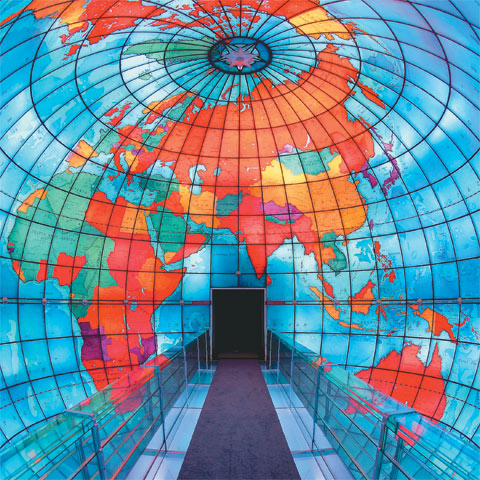
And so yesterday, to counterbalance this woeful state of affairs, I visited every cartophile's dream place: the Mapparium at the Mary Baker Eddy library. Mary B.E. was the founder of the Christian Science movement, and the Mapparium was built to symbolise the movement's far-reaching, international significance (although those of us with atheist leanings can equally take it to symbolise the far-reaching, international significance of just about anything). It is a room with stained-glass walls that form a giant, inside-out globe. You go through a door, out onto a bridge, and you are STANDING INSIDE A MAP OF THE WORLD.

Source: thephoenix.com
It's not just any old map of the world, either, but a map of the world as it looked in 1935, peppered with defunct place-names like Czechoslovakia and Yugoslavia, Abyssinia and French West Africa, Siam and Indochina. The shape of the room - which also makes for some bizarre whispering-gallery acoustics - hammers home the things that flat maps cannot quite depict: how wide the world is around the equator, how far north we are in Europe, how tiny the UK really is, what a great distance it is from Montreal to Buenos Aires... The only problem, I discovered, as I was craning my neck to look at the North Pole and leaning out over the bridge to look at the South, is trying to take in the whole world in the twenty-minute allotted time slot. It's impossible.

Today, I will appease my inner cartographer in a more everyday fashion. I will buy a map of Boston made of ink and folded paper.

Friday, 12 July 2013

Street journeys

I have a curious premonition that journeys will be a recurring theme of this blog. There will be solo journeys and group journeys, around and between cities, across oceans, continents and borders; journeys to the country, to the mountains, to the coast; journeys on planes, trains, buses and boats, on public transport and on foot. I'm hoping there will be plenty of internal transportation, of the kind set in motion by a good book, and doubtless, by the end, I'll realise I've been on some kind of metaphorical, spiritual journey too, though I promise to spare you the details of that.

The current stage of my trip is characterised by urban, pedestrian journeys around Brooklyn and Manhattan, every one of which, be it down a street or round a block or across a park, serves to reaffirm the vastness of this endless, unconquerable city. I am currently reading this appropriately-themed book, selected from my host KC's extensive collection of intriguing tomes:


New York, the author claims, is one of the great walking cities, even though the systemised grid layout of the streets - 'each block present[ing] you with a traffic signal and the instruction to walk or not walk' - puts many people off exploring it on foot. With my tendency to prioritise aesthetics over logic, I initially found the idea of a grid system decidedly lacking in imagination. Numbers over names, convenience over quirks - it all seemed so unromantic. But it's grown on me. I like that you can estimate the distance of one address from another without having to look at a map. I like that you can track your progress down a street by counting the number of cross-streets that intersect with it. I like that the grid system fits with New York's angular, constructed geometry, with the straight lines and right angles that define its iconic aesthetic. Most of all, I like the words that the system necessitates, each of them singularly American and slightly wooden-sounding in my English accent: block, sidewalk, crosswalk, cross-street, intersection, avenue. They have a utilitarian romance to them. They are simultaneously familiar (because everyone uses them In The Movies) and exotic (because no British person uses them in his or her everyday speech).

It sounds from the above like I have been walking a lot, but I haven't - not really. When I lived in London, I walked all over the place. It was a way of making the city my own and of piecing together a landscape fragmented by underground travel. Whenever I visit a new city I walk as often and as far as I can, attempting to trace a path across it rather than skimming over (or under) the surface. But there has been a significant barrier to my doing so in New York: the stagnant, grimy heat the city has been enduring of late. My walks have therefore been purposeful and as efficient as I can make them, frequently aided by Google maps and the subway. But yesterday it was a little cooler, and I took the opportunity to wander round a place that usually gets forgotten by New Yorkers and tourists alike: Roosevelt Island.

It is an eerie, fascinating place. Two miles long and only 800 feet across at its widest point, it sits in the middle of the East River, connected to Manhattan by cable car, Queens by road bridge, and to both by subway. But despite its central location, and even though it was the site of my most substantial pedestrian journey yet (I walked its length twice and its breadth four or five times), Roosevelt Island feels less like a place where journeys happen than a place where journeys end.

Neither the cable car nor the traffic on the road bridge continue on through the island to the opposite shore, but must stop there, turn around, and go back the way they came. Even though the bustle of Manhattan is clearly visible - and audible - from the west side, the island itself feels adrift in a time and a place apart. Its main and pretty much only street is called - you've guessed it - Main Street (no grid system here), which gives it a small-town, provincial feel. Many of its residential buildings have the tired, run-down appearance that is the fate of most 1970s architecture. Apart from a new development clustered around the subway station, its businesses cannot keep up with the fashions and fads of those across the water, and nor do they try.

At both the north and south ends of the island are branches of the Coler-Goldwater Specialty Hospital, a chronic care facility - not the kind of hospital you pass through during a temporary sickness, but the kind where you stay a while. The island was also once home to the New York City Lunatic Asylum, the Charity Hospital, and the Smallpox Hospital, where sufferers of unpleasant contagious diseases were quarantined, and which now stands in ruins on the island's south tip. At other times in its history, it was the site of a penitentiary and a workhouse. For many former residents, their journey to Roosevelt Island was likely to be their last.

The old Smallpox Hospital - to be converted to a museum within the next five years.

And now, as an antidote to the doom and gloom into which this post has somehow descended, here's a list of the FUN things I've been up to. While in New York, I have: played in the sprinklers at the Brooklyn Botanic Garden; seen the ORIGINAL Winnie-the-Pooh and friends, as played with by Christopher Milne (aka Christopher Robin); been a quintessential tourist at Grand Central Station and the Metropolitan Museum; walked the High Line, a former elevated railway that's now a park; danced to jazz in Williamsburg and to 'Twist and Shout' at an outdoor screening of Ferris Bueller's Day Off; seen the New York Philharmonic in a park; been to a flea market; drunk a 'Rose Tyler' at a Doctor Who-themed bar, stuffed my face with pizza slices and practically drowned in iced coffee. On my list for today: Washington Square Park, and doughnuts. Sorry, donuts. Better get on and do that.

The real Winnie-the-Pooh and Piglet; A.A. and Christopher Milne in the background.

Friday, 5 July 2013

In which I start to chill (the fuck) out

I'm here! In America, New York, Brooklyn, my friend KC's apartment. The plane stayed airborne, the US border officials stamped my passport without turning a hair, and I arrived intact, if exhausted, to my destination, where I was welcomed by two friendly New Yorkers and an affectionate cat. It's now day #2 of my long-awaited five month adventure, which will see me exploring the US until the end of August, Canada in September, and Argentina in October and November.

It hasn't all been plain sailing: my last fortnight in the UK was overshadowed by an endless to-do list, neuroses to rival those of Woody Allen (I still haven't quite shaken the fear that I will get bitten by a rabid mammal and die, alone in a strange land), and looming emotional goodbyes. I had forgotten all my reasons for wanting to embark on such an ambitious project. I could no longer recall why it had once seemed like such a good idea, why I had felt it necessary to take off on my own for so long, why I couldn't just go to France for a fortnight with a couple of friends and have done with it. All my hankering for adventure had dissipated; I was peeling myself away from a life I loved to pursue a kind of freedom that no longer interested me.

Everyone said it would be fine once I got there, and of course, everyone was right. I am fine. That's not to say I am completely unfazed by the thought of those five months (21 weeks, 148 days) stretching out before me, in which I will have no space that is really mine and no possessions that don't fit into a backpack. But I have some very dear friends here in America, and even though later on I'll be visiting places where I know no one, the Couchsurfing website (which puts travellers in touch with people willing to give them a bed for a night or several - and with each other) is a failsafe way to prevent loneliness in far-flung lands. I've barely been here 48 hours and it has already proved its worth: at around noon yesterday I bought sausages and lemonade and made my way to the Couchsurfing 4th July Potluck Barbeque in Prospect Park. Nine hours later, I was standing on a pier in Manhattan with a group of six different nationalities (American, Bolivian, South African, Swedish, British, New Zealand(ish?)), watching the fireworks over the Hudson River. At the end of the evening, we exchanged contact details and promised to meet again before we all leave. Experiences like this reassure me that even if I am travelling alone, I need never be lonely.

Other than that, my new Travel Shoes have had their maiden voyage and been baptised in Prospect Park mud; I have discovered coffee ice cubes (iced coffee dilution-prevention); I have had a bagel breakfast. This morning, as I ate an orange and watched a colony of Brooklyn ants diligently transporting their eggs from A to B, it started to dawn on me: I am here. This isn't just an idea any more. There are details now, like the sight of those ants and the taste of this orange. I set aside the time and raised the money to fulfil my longest-held dream, and now I am living it.

I have spent the past month telling myself, and listening to other people telling me, that everything about this trip will be okay. Now, finally, I'm actually starting to believe it - aided, in part, by this sign I saw today:


Amen to that.